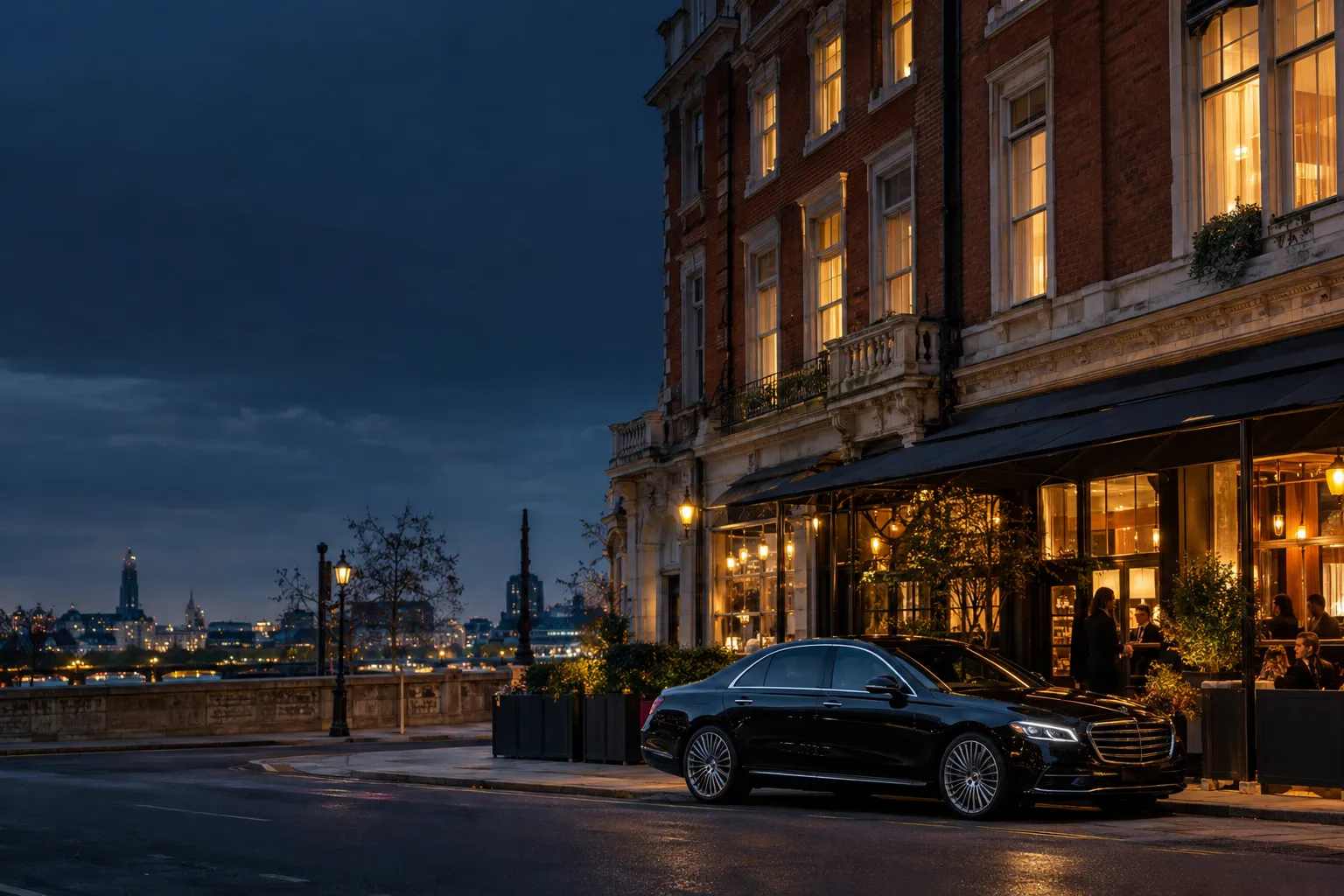
A practical guide to arranging pre-booked private-hire transport around a London dinner, from choosing a clear pickup point to confirming the return journey and understanding what is not automatically included.
Chauffeur hire for a restaurant evening is a pre-booked private-hire journey connected with dining out.
In London, private-hire vehicles cannot be hailed or taken from taxi ranks; book through a licensed operator in advance, as TfL advises.
Private-hire journeys must be arranged in advance
Pre-booked
Destination covered by this guide
London
Vehicle, waiting and return arrangements
Confirm directly
Private hire and taxis are distinct
Separate rules
The dining and transport context
A practical introduction to chauffeur hire for dinner in London
Start with the occasion and the destination. The transport arrangement should support the evening, not imply access or service features that have not been confirmed.
What chauffeur hire means for a London restaurant evening
A restaurant evening in London can involve more than travelling from one address to another. The choice of venue may be shaped by the occasion, the people attending, the area of the city and the time available. Transport matters because it frames both ends of the experience: arriving with a clear plan and knowing how the journey home will be arranged.
Chauffeur hire for restaurant evenings means arranging a pre-booked private-hire journey in connection with dining out. Depending on the arrangement confirmed with the operator, the journey may simply be a collection and drop-off, or it may involve more than one agreed stop. The phrase does not, by itself, promise a particular vehicle, waiting time, restaurant access or return arrangement. Those details need to be discussed and confirmed before the evening.
This guide explains how to think through the transport element without letting it take over the occasion. It covers choosing a restaurant area, sharing useful journey information, understanding the distinction between private hire and taxis, and checking what has actually been agreed.
Why transport planning belongs alongside the restaurant choice
London’s dining scene ranges across cuisines, budgets and settings. A meal might be a relaxed get-together, a special occasion, a business dinner or a reservation at a restaurant selected for a particular menu. Visit London’s restaurant information and the MICHELIN Guide’s London listings can help readers explore options, but restaurant guides do not establish whether a transport provider serves a particular venue or can stop at its door.
The practical value of arranging a car is not that it changes the restaurant experience. It is that the transport plan can be considered alongside the reservation. For instance, guests may want to coordinate a collection for a group, avoid making separate arrangements at the end of dinner, or agree a known destination for the journey home. Whether those arrangements can be provided depends on the operator and the specific booking.
The term chauffeur is also often used conversationally for a private-hire car with a driver. In London, the distinction that matters for passengers is that private-hire journeys must be booked in advance through a licensed operator. TfL says private-hire vehicles cannot be hailed on the street or use taxi ranks. A black cab may be hailed or found at a rank, or booked through an appropriate channel. Do not assume that a pre-booked private-hire collection works like an on-demand taxi pickup.
Choose the restaurant and reservation time first, then consider the journey around them.
Treat restaurant listings as venue discovery tools, not as confirmation of transport access.
Arrange private hire in advance rather than expecting to hail a private-hire car.
Planning the route
How to organise the collection, restaurant stop and return
Clear journey details are more useful than assumptions about access, waiting or flexibility. Confirm both directions and every planned stop.
Choose the restaurant area and make the destination clear
The most useful first decision is the restaurant area, not a vehicle description. London dining options are distributed across different neighbourhoods, and the chosen location influences the collection and destination details that an operator needs. If the party is travelling from a hotel, home or another appointment, provide the actual pickup address rather than only a district name.
If you have not settled on a venue, use current restaurant directories to compare cuisine, occasion and location. Visit London provides broad restaurant information, while the MICHELIN Guide offers a searchable London selection. Listings and awards can change; check the restaurant’s own current information for its address, booking terms and arrival instructions. Neither directory should be treated as evidence that a particular vehicle can enter a private forecourt or stop immediately outside.
For a dinner with several guests, agree where everyone will meet before the vehicle is booked. A single clear pickup point is easier to communicate than a series of informal meeting locations. If the party will be collected from different addresses, ask whether a multi-stop arrangement is possible and how it affects the quoted journey. Do not assume that extra stops are included.
A restaurant may have a main entrance, a separate access point or local restrictions on stopping. Tell the operator the restaurant’s full name and address, and ask where the vehicle is expected to meet the party. If the restaurant provides specific arrival guidance, share it. The operator can confirm what is feasible; venue rules and road conditions are separate matters.
Restaurant name and full address
Reservation time and any useful arrival instructions
Pickup address, including the correct entrance or meeting point
Passenger count and any relevant luggage or accessibility needs
Whether the plan includes a return journey or another agreed stop
Plan the outward journey and the journey home separately
An evening plan should distinguish between arriving at dinner and getting home afterwards. These may be two separate bookings, or a return journey may be arranged as part of one agreed plan. The arrangement is not automatic: confirm whether the return is included, what time or collection method applies, and how any changes are handled.
A defined return time can be awkward if dinner runs longer than expected. On the other hand, leaving the end of the evening entirely open may not match the operator’s booking terms. Discuss the likely finish and ask what options are available if the meal ends earlier or later. Do not assume that a driver will wait through dinner, remain nearby, or be available on demand unless the operator has explicitly confirmed that arrangement.
For a multi-stop evening, list each destination in order before confirming. This may include a first collection, the restaurant and a separate final address. Each stop should be described accurately so that the operator can assess the journey and explain any price or timing implications. A route that changes on the night may need to be agreed again.
Time estimates in a large city should be treated as planning estimates, not guarantees. The time needed can vary with traffic, road works, weather, events and the exact collection point. Allow an appropriate margin before a reservation and check current travel information close to departure. The restaurant’s reservation time is not necessarily the time at which a vehicle can reach a specific kerbside point.
Is the return journey part of the arrangement?
Is a fixed collection time agreed, or is another return plan available?
Can the itinerary include an additional stop?
How should a delay or a change of destination be communicated?
What is the agreed pickup location after dinner?
Clear expectations
What to clarify about passengers, luggage and pickup
Vehicle and passenger details are booking facts, not assumptions to make from a broad service label. Confirm anything that affects comfort or access directly.
Private hire, black cabs and the rules passengers should understand
London private hire and taxis are not interchangeable booking arrangements. TfL’s passenger guidance explains that private-hire journeys, including chauffeur and executive-car journeys, must be booked in advance through a licensed operator. Private-hire vehicles cannot be hailed in the street or use taxi ranks. A taxi, including a black cab, operates under different rules and may be hailed or taken from a rank.
This distinction matters at the end of dinner. If a private-hire vehicle has been arranged, use the confirmed booking details and collection instructions. Do not expect to find that vehicle at a taxi rank or flag it down if the original plan changes. If you need a different journey, use an appropriate booking channel and make sure the new arrangement is confirmed.
TfL also publishes guidance on what passengers can expect from taxi and private-hire journeys. Passengers should check that the vehicle and journey correspond to their booking and follow the relevant operator’s instructions. These are general points about London transport; they are not a statement about the licensing status, procedures or features of any particular company. Check the operator’s current credentials and booking information directly.
The distinction is useful even when a restaurant is in a busy area. A pre-arranged pickup gives the parties a planned meeting point, but it does not guarantee a particular kerbside location or priority access. Road restrictions, venue arrangements and local conditions can affect where stopping is possible. Confirm the intended collection point and have a clear way to contact the operator if it needs to change.
Private hire must be booked in advance through a licensed operator.
Private-hire vehicles cannot be hailed or use taxi ranks.
Use the booking’s agreed pickup instructions rather than assuming a street-side collection.
Check the operator’s current information; general TfL guidance does not verify a particular provider.
Passenger numbers, luggage and individual requirements
The details of the party affect what needs to be agreed. Give an accurate passenger count and explain any specific needs before confirming the journey. Do not infer seating capacity from a vehicle category or assume that a particular model will be supplied. Ask the operator to confirm the vehicle and passenger arrangements for the booking.
Mention luggage even for a restaurant evening. Bags, shopping or items carried from another appointment can affect the space required. If the party has a pushchair, mobility equipment or another bulky item, describe it clearly and ask whether the proposed arrangement can accommodate it. The company’s answer should be confirmed rather than guessed from a photograph or a general vehicle label.
If a guest needs assistance getting into or out of a vehicle, or has a particular access requirement, raise it at the time of enquiry. Ask specific questions about the relevant vehicle and journey. Do not assume that a standard chauffeur booking includes specialist accessibility equipment or a particular level of assistance.
For groups, coordinate the meeting point and make sure all passengers know the plan. One person can be responsible for keeping the booking details and communicating any change to the operator. Avoid sharing a different pickup address with different members of the party unless the operator has agreed to those separate collections.
Confirm the passenger count before the booking is finalised.
Describe luggage and any bulky items that need to travel.
Raise mobility or access requirements directly with the operator.
Ask which vehicle and arrangements are confirmed rather than assuming a model or capacity.
Service distinctions and practical standards
What is included, what is not automatic, and how to prepare
A useful arrangement is one whose boundaries are understood by both the passenger and the operator. Clarify the specific service rather than relying on broad labels.
Understand the difference between a drop-off, return and waiting arrangement
The phrase restaurant chauffeur hire can suggest several different things: a one-way collection, a return journey, an hourly arrangement or a sequence of stops. These are not the same service. A short trip to dinner does not establish that the driver will stay, that waiting is included, or that a return journey is reserved. Ask for the exact arrangement in writing or in the booking confirmation.
For an occasion with a known timetable, a direct collection and drop-off may be straightforward to discuss. A long dinner or an event following the meal may call for a different plan. If the operator offers a relevant option, compare its stated terms with the actual evening rather than choosing based on a name alone. Details such as start and end times, included waiting, additional stops and changes should be explicit.
Pricing can depend on the itinerary and the operator’s terms, so a general figure cannot responsibly be supplied here. When requesting a quote, provide the pickup and destination addresses, date and expected times, passenger count, stops and vehicle requirements. Ask what the quote covers and whether any proposed changes would alter it. This makes comparisons more meaningful than asking for a price based only on the words “restaurant chauffeur.”
London Direct Chauffeurs describes its own pre-booked chauffeur services for London and the United Kingdom, including hourly chauffeur hire and event transport. As the publisher, we mention this as a practical option to enquire about when an evening involves a planned collection or a more involved itinerary. Confirm the specific restaurant journey, vehicle and terms directly; no venue affiliation or special access is implied.
One-way collection and drop-off
A return journey with an agreed collection plan
An hourly arrangement, if offered and confirmed
A multi-stop itinerary agreed before travel
Make the pickup and late-evening arrangements understandable
Good communication is part of making a pre-booked journey workable. Ensure the booking name, date, pickup address and restaurant destination are correct. Save the operator’s confirmed contact method and booking reference if supplied. If the restaurant or pickup point changes, communicate the change promptly and wait for confirmation that it can be accommodated.
At pickup, use the agreed location and follow the operator’s instructions. If the area is busy, do not assume the vehicle can stop at the restaurant entrance. A nearby meeting point may be necessary, but it should be agreed rather than improvised. After dinner, identify the correct collection point before leaving the restaurant, especially where several streets or entrances could be confused.
Personal safety remains important when travelling at night. TfL provides Safer Travel at Night information, and passengers can consult it for general guidance. Use the booking details to verify the journey and avoid entering a vehicle that does not match the confirmed arrangement. For any concern, contact the operator or appropriate authorities rather than relying on assumptions.
These practical checks are not a substitute for the operator’s own terms. The precise pickup procedure, contact arrangements and response to delays vary. Read the confirmation and ask unresolved questions before the evening, when there is more time to make a clear plan.
Keep the confirmed itinerary and contact details accessible.
Use the agreed pickup point and check any change with the operator.
Verify that the vehicle corresponds to the booking.
Consult TfL’s general night-travel guidance where useful.
Putting it together
A simple, reliable plan for the evening
A few confirmed details can prevent most planning ambiguity without overcomplicating the evening.
A concise planning checklist for dinner in London
A restaurant evening is best planned as a small itinerary: where the party starts, when it needs to arrive, where the restaurant is, and how everyone will leave afterwards. Keep the plan proportionate. A simple dinner may need only a confirmed collection and destination, while a celebration or business evening may involve a return or an additional stop.
Before settling the transport, check the restaurant’s current address and arrival instructions. Then give the operator the same details, including a useful contact person for the group. If guests are meeting at the restaurant independently, make clear whether the vehicle is for one passenger or the whole party. This avoids an accidental mismatch between the plan and the booking.
Consider the return before the meal begins, not after it ends. Agree what happens if the restaurant runs late, the party wants to leave early, or the destination changes. The operator may offer options, but availability and terms must be checked. Do not rely on an unconfirmed expectation of a driver waiting nearby.
Finally, leave room for ordinary uncertainty. Traffic and local stopping conditions can affect arrival, and a late-running dinner can affect the return. Communicate changes promptly, follow the operator’s instructions and keep the group informed. With those basics settled, transport can remain a practical part of the evening rather than an unresolved question.
Verify the restaurant’s address and reservation details.
Give the operator accurate pickup and destination information.
Agree the return plan and the process for changes.
Confirm passenger, luggage and vehicle requirements directly.
Use current TfL guidance for general private-hire and night-travel information.
The essential point
Chauffeur hire for restaurant evenings in London is a pre-arranged transport choice, not a guarantee of a particular car, restaurant entrance, waiting period or return service. The useful approach is to begin with the meal, make the itinerary precise, understand the difference between private hire and taxis, and confirm all material details with the operator.
For venue discovery, consult current restaurant sources such as Visit London and the MICHELIN Guide. For transport rules and general passenger guidance, consult Transport for London. Keep those roles distinct: restaurant listings help with dining choices, while the operator confirms the actual journey and its terms.
Common questions
FAQs about restaurant-evening chauffeur hire
Answers depend on the journey and operator terms; confirm specific arrangements before the evening.
Is chauffeur hire for dinner the same as booking a taxi?
The key is to confirm the pickup, restaurant destination, passenger details and return arrangement directly with the operator. Private-hire transport in London must be booked in advance, and the details of waiting or additional stops should never be assumed.
Can a private-hire vehicle be hailed outside a restaurant?
No. TfL says private-hire vehicles must be booked in advance through a licensed operator and cannot be hailed or use taxi ranks. Taxis operate under different arrangements.
Will the driver wait while we have dinner?
Not automatically. Ask whether waiting is available, what period or terms apply, and whether an alternative return collection can be arranged. Confirm the answer before travel.
What information should I provide when enquiring?
Provide the full restaurant name and address, reservation time, pickup location, passenger count and any relevant luggage or access requirements. Also say whether the booking is one-way, return or multi-stop.
Can the car collect us at the restaurant door?
Do not assume that collection can take place at the restaurant entrance. Ask the operator about the agreed meeting point and share any arrival guidance from the venue.
Further reading
Sources and further information
Use current official and destination sources for details that may change.
Visit London: restaurants
For current restaurant information and destination research.
The MICHELIN Guide: London restaurants
For London restaurant listings and cuisine information.
Transport for London: what to expect from your journey
For private-hire passenger guidance and the distinction between taxis and private hire.
Transport for London: Safer Travel at Night
For general advice about travelling safely at night.
Questions answered
chauffeur hire for restaurant evenings in London FAQs
Is chauffeur hire for dinner the same as booking a taxi?
No. TfL says private-hire vehicles must be booked in advance through a licensed operator and cannot be hailed or use taxi ranks. Taxis operate under different arrangements.
Can a private-hire vehicle be hailed outside a restaurant?
No. Private-hire journeys must be booked in advance through a licensed operator.
Will the driver wait while we have dinner?
Not automatically. Ask whether waiting is available, what period or terms apply, and whether an alternative return collection can be arranged. Confirm the answer before travel.
What information should I provide when enquiring?
Provide the full restaurant name and address, reservation time, pickup location, passenger count and any relevant luggage or access requirements. Also say whether the booking is one-way, return or multi-stop.
Can the car collect us at the restaurant door?
Do not assume that collection can take place at the restaurant entrance. Ask the operator about the agreed meeting point and share any arrival guidance from the venue.