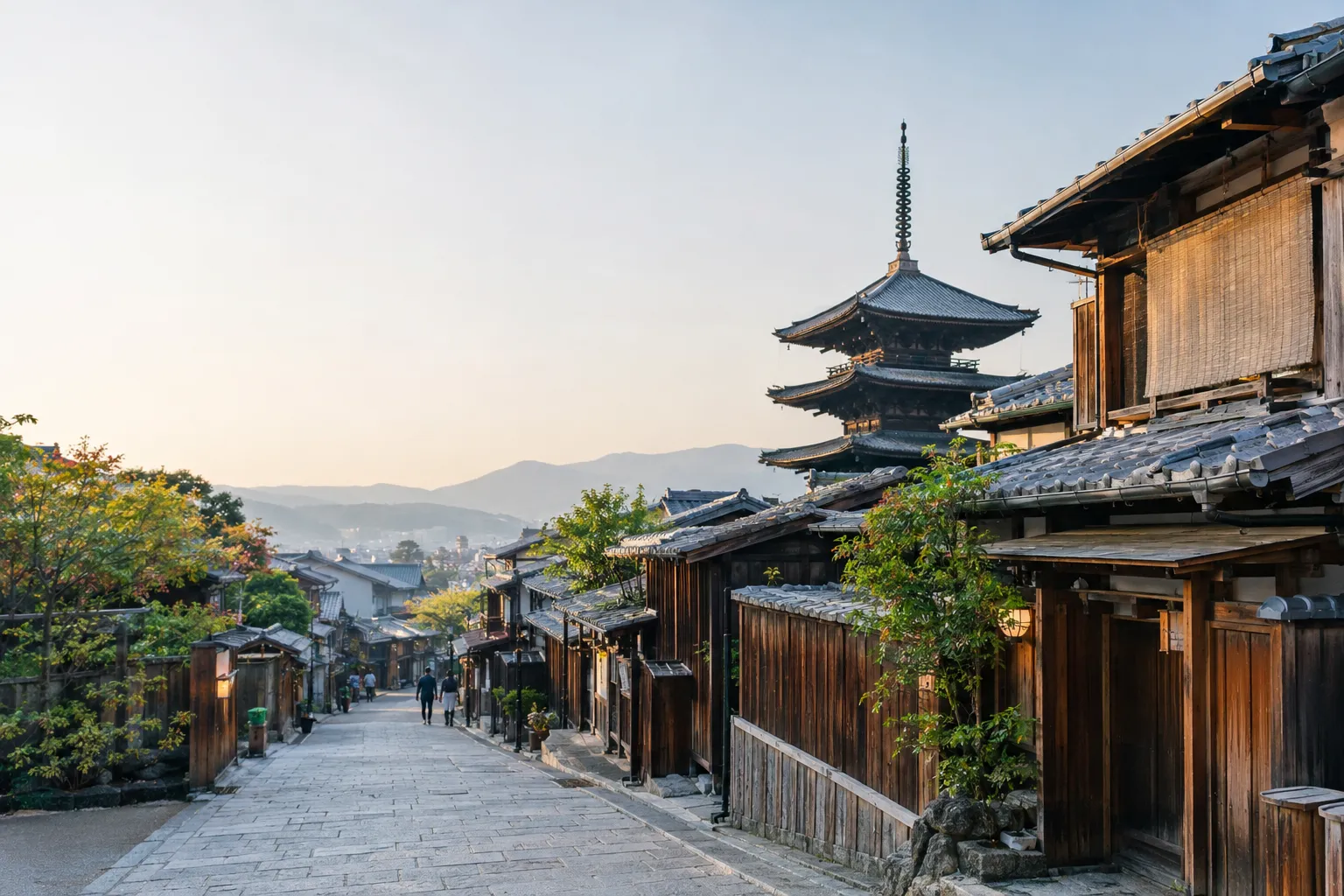
The most satisfying Kyoto stay joins a place to its surroundings: the kind of building you return to, the streets outside it and the cultural places you visit from there. These distinctions help make a thoughtful choice without assuming that every historic-style property offers the same experience.
How to think about heritage hotels in Kyoto
Kyoto is best understood as a city of layered neighbourhoods. A former capital with a long imperial and religious history, it is also a lived-in urban place where shops, homes, workshops and places of worship occupy streets that visitors may experience as cultural landscapes. The difference matters when choosing a hotel: a stay in a historic district can make the ordinary rhythm of the area part of the journey, while a centrally located contemporary hotel may make it easier to move between several parts of the city.
The phrase “heritage hotel” can describe very different things. It may refer to a historic building adapted for guests, a traditional-style inn, or a modern property drawing on local materials and design. Kyoto’s official visitor guide also identifies kyo-machiya, traditional wooden townhouses renovated for overnight stays, as a distinctive accommodation option. These categories should not be treated as interchangeable. A period building, a townhouse stay and a newly built hotel inspired by Kyoto each offer a different relationship with the city’s past.
The most useful starting point is therefore not a star rating or an image of a tatami room. It is the kind of Kyoto experience you want to have: quiet residential lanes, historic entertainment-district atmosphere, access to major cultural sites, or a more urban base close to shopping and dining. Once the neighbourhood is clear, the right accommodation style becomes easier to assess.
Kyoto’s history as a living urban setting
The city’s history is not a decorative backdrop. Kyoto became the imperial court’s home in 794 and served as Japan’s capital for more than a thousand years. That long role shaped religious institutions, courtly culture, craft traditions and the networks of streets and districts that still help define the city. The official history guide presents this heritage as a continuing culture as well as a record of historic places.
For a visitor, that continuity is apparent in the contrasts. A street may lead from a busy commercial route into a quieter lane; a contemporary restaurant may sit within a district associated with older forms of trade; and a temple visit may be part of an everyday local landscape rather than an isolated excursion. The appeal of a heritage-oriented stay lies partly in noticing those transitions over time, rather than treating the city as a set of disconnected sights.
This also calls for care in how historic character is interpreted. Not every old-looking façade indicates a preserved original building, and not every property described as traditional has the same history or construction. When a hotel’s heritage is important to your decision, check the property’s own account of its building, restoration and present-day facilities. Distinguish documented history from design inspiration, and let the neighbourhood itself provide context rather than assuming that a particular interior represents all of Kyoto.
Gion and Kiyomizu: historic streets and cultural life
Gion and Kiyomizu make a compelling base for travellers drawn to traditional streetscapes and historic landmarks. Kyoto’s official area guide describes Gion through its tea houses and traditional entertainment-district character, while the wider Kiyomizu area is associated with historic temples, craft shops and nearby sights. Together, they offer a strong sense of how cultural life, religious places and visitor routes intersect in eastern Kyoto.
The neighbourhood is not simply a theatrical setting. Its streets are also part of the daily environment of residents and businesses. Visitors should move respectfully, keep to public ways, avoid obstructing entrances and follow local signs. The official guide specifically cautions against photographing maiko without permission. That advice is a reminder that people are not attractions to be approached or photographed as part of a sightseeing itinerary.
A hotel in or near this area may suit someone who values early or late walks through the district and wants to orient a stay around eastern Kyoto. But convenience depends on the exact address, the day’s plans and the traveller’s tolerance for busy visitor routes. Read the property’s location description closely, check its access guidance and consider how far it is from the places you expect to visit. “Gion” in a hotel description does not by itself establish a particular walking time or quiet setting.
- Pair the area’s historic streets with time for temples, craft shops and pauses between major stops.
- Follow posted guidance and respect the privacy of residents, workers and visitors.
- Check the accommodation’s precise location rather than relying on a broad neighbourhood label.
Central Kyoto: history alongside the contemporary city
Central Kyoto presents a different kind of historic stay. The official area guide describes it as a mix of historical sites, traditional culture, shopping and dining, and identifies places including Nijo Castle, Kyoto Imperial Palace, Nishiki Market, Pontocho and Gion. The character here is less defined by one historic street scene and more by the close coexistence of important sites and active city life.
For a visitor, that variety can be an advantage. A central base may make it practical to combine a cultural visit with a meal, market browsing or an evening in a different part of the city. The trade-off is that “central” covers a broad area, and an address that is convenient for one destination may not be the most suitable for another. Look at the accommodation’s actual location in relation to the places that matter to your plans.
Central Kyoto can also be a useful choice for travellers who prefer a contemporary hotel with familiar facilities while keeping historic sites within the wider daily itinerary. Heritage does not require every night to be spent in a historic building. A thoughtfully chosen base can provide a contrast: the comfort and straightforward routines of a modern property, followed by a day among older streets and cultural landmarks. The important point is to select by the experience you want, rather than assuming that one accommodation style is inherently more authentic.
Nishijin and Kamishichiken: craft, sweets and district identity
Nishijin offers a more craft-centred perspective on historic Kyoto. The visitor guide connects the area with the city’s textile history and highlights traditional sweets shops there. Nearby Kamishichiken is described as Kyoto’s oldest geiko district. These details make the area rewarding for travellers interested in the relationships between craft, food and neighbourhood identity, rather than only landmark-to-landmark sightseeing.
The character of a district is often easiest to appreciate at a measured pace. A visit might take in the local streets, a craft-related point of interest and a traditional confectionery stop, with enough time to notice how the surroundings change from one block to the next. The official guide notes that the featured sweets shops are reachable by city bus, but transport details and conditions may change; check current local information when planning a visit rather than relying on an old timetable or assuming a particular service pattern.
A stay in this part of Kyoto may be appealing to someone seeking a quieter or more locally inflected base, but no neighbourhood should be reduced to a promise of tranquillity. Individual streets, travel dates and property locations matter. Review the accommodation’s address, access information and guest facilities, then decide whether the area’s textile and food associations suit the trip you are planning.
- Explore Nishijin with an interest in textiles, local history and traditional sweets.
- Treat Kamishichiken as a lived-in district, and observe local customs and signage.
- Verify current transport and venue information before setting a fixed itinerary.
What a kyo-machiya stay can and cannot tell you
A kyo-machiya is a traditional wooden townhouse, and Kyoto’s official accommodation guide notes that renovated examples are used for overnight stays. It also indicates that some offer cultural experiences. This makes the format an appealing way to encounter a domestic architectural setting, but it does not mean every townhouse stay has the same layout, history, service or activities.
The building form can shape the practical experience. Older houses may have room arrangements and circulation unlike those of a conventional hotel. Before booking, read the specific property description for sleeping arrangements, bathroom details, stairs, heating or cooling information, luggage guidance and any house rules. If accessibility, privacy or particular facilities are essential, confirm them directly with the accommodation. Do not infer them from photographs or from the general label kyo-machiya.
It is also worth asking what “heritage” means in the listing. Is the property a documented historic building, a renovated townhouse, or a newer space designed with traditional references? Each can be an interesting choice, but clarity helps set expectations. The best fit is the property whose actual facilities and setting match your needs, not simply the one whose visual language most closely resembles an imagined version of old Kyoto.