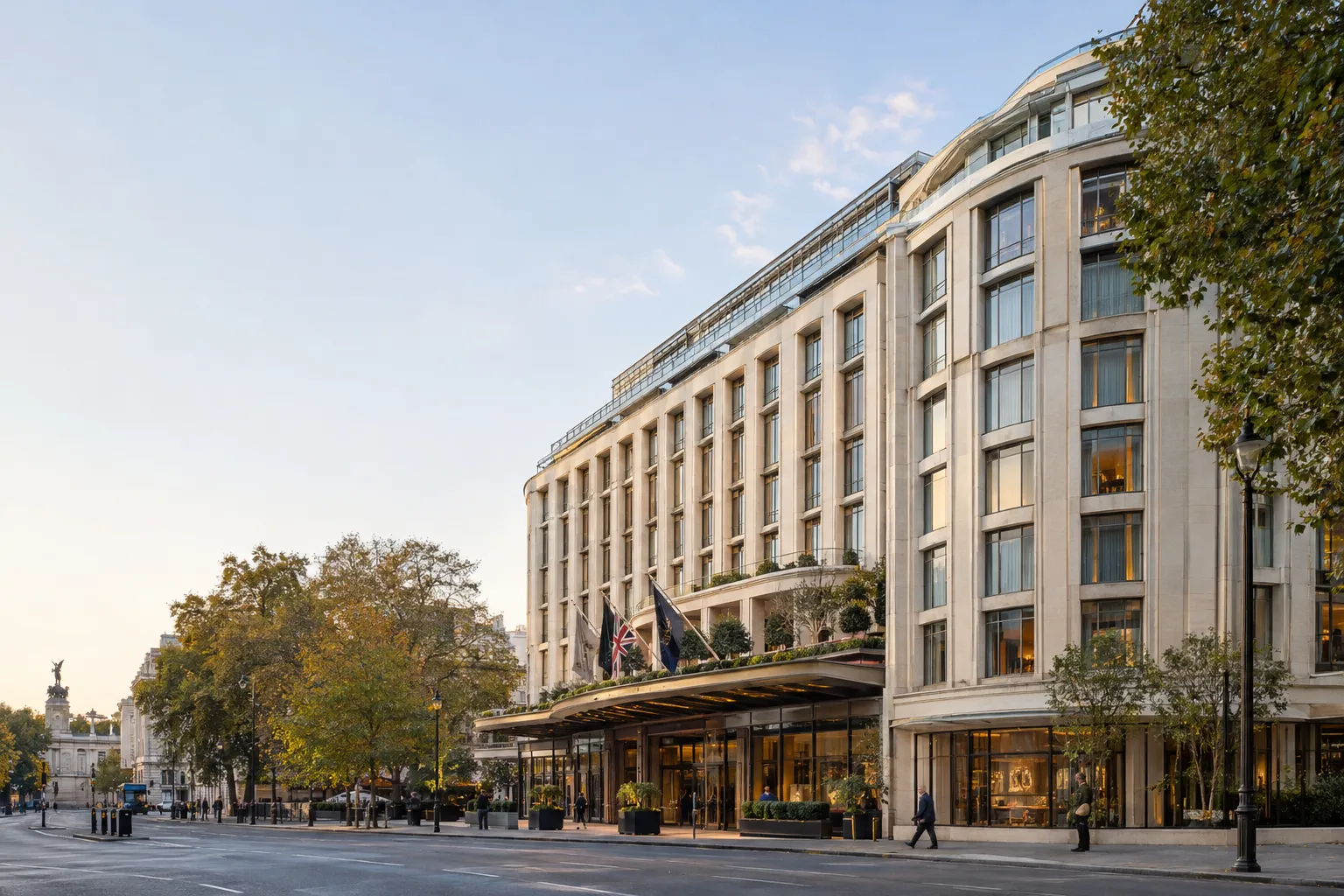
The Peninsula London sits at the meeting point of Belgravia, Hyde Park Corner and Wellington Arch. This guide explores the hotel’s setting, rooms, dining and spa, with practical context for planning time in the neighbourhood.
The Peninsula London is at 1 Grosvenor Place, London SW1X 7HJ, near Hyde Park Corner and Wellington Arch.
The hotel welcomed its first guests on 12 September 2023 and offers rooms, suites, dining and spa facilities described on its official pages.
Official hotel address
1 Grosvenor Place, London SW1X 7HJ
First guests welcomed
12 September 2023
Listed by The Peninsula Spa London
7 treatment rooms
Hyde Park pedestrian gate hours listed by The Royal Parks
5:00am–midnight
Setting
Understanding The Peninsula London’s setting
Start with the address and the city landscape around it. The hotel’s position explains much of its particular appeal.
The Peninsula London and its place at Hyde Park Corner
The Peninsula London occupies a distinctive point on the city map: the edge of Belgravia, facing Hyde Park Corner and close to Wellington Arch. That setting offers a useful way to understand the hotel. It is not simply a place to sleep, dine or pause between appointments; it sits where a historic residential district, a major London park and the ceremonial routes around the royal parks meet. For visitors, the location provides a strong sense of arrival without requiring the hotel to be isolated from the city around it.
The hotel is at 1 Grosvenor Place, London SW1X 7HJ. Its official description places it near Hyde Park Corner, Wellington Arch and Kensington Gardens. These are not interchangeable attractions: the arch is a landmark at a busy junction, Hyde Park offers space for walking and time outdoors, while Belgravia is defined by its own quieter streets and architectural character. Together they give a stay several different rhythms, from an urban crossing to a park walk or a neighbourhood wander.
The Peninsula London welcomed its first guests on 12 September 2023. As a comparatively recent London arrival, it brings the Peninsula name to a setting already shaped by long-standing institutions and established streets. That contrast is part of the interest. The hotel’s contemporary hospitality is placed within an area whose significance is legible in its parks, ceremonial landscape and surrounding built environment. Readers considering the property can therefore think about two linked questions: what the hotel offers indoors, and what its position makes convenient outdoors.
For a first visit, it helps to orient yourself around Hyde Park Corner rather than treating the hotel as a generic central-London address. The junction is a useful reference point, but it can feel busy and expansive. Wellington Arch gives it a recognisable focal point, and the entrances and paths of the park offer a different pace nearby. The exact route between any two places depends on current access and traffic conditions, so a map and live information remain sensible companions.
Belgravia, Hyde Park and the character of the location
The hotel’s Belgravia setting connects it with a district often experienced through its streets and squares rather than through a single headline sight. That is useful for visitors who want an itinerary with room to breathe. A morning can begin with the hotel’s own surroundings, continue through a walk in Hyde Park, and return to Belgravia for a meal or a rest. Alternatively, the area can serve as a base for moving between several central London neighbourhoods. These are possibilities created by location, not a claim that every attraction is immediately beside the entrance or that journeys will take a fixed amount of time.
A good neighbourhood visit is often less about accumulating stops than understanding transitions. At Hyde Park Corner, traffic, memorials, park gates and the arch produce a grand, open urban scene. A short distance away, Belgravia’s streets feel more contained. The change in scale is part of the pleasure of walking here. Visitors should allow for crossings, park entrances and the time needed to navigate a large junction; straight-line distance on a map can make a route look simpler than it feels on foot.
The location is also a practical consideration when choosing a London hotel. Those whose plans centre on the west side of central London may value being near the park and the Belgravia area. People whose schedule is concentrated elsewhere should compare the hotel’s position with their actual destinations and transport preferences. A beautiful setting does not remove the need to plan around the shape of a trip. It gives that trip a particular base and atmosphere.
The area’s public spaces are living places, not a private extension of the hotel. Park access, events, temporary closures and visitor arrangements can vary. The Royal Parks publishes current visitor information for Hyde Park, while English Heritage provides visitor details for Wellington Arch. Checking those pages close to the visit is more reliable than relying on a remembered schedule or an old itinerary.
Accommodation
Rooms and suites at The Peninsula London
The hotel’s room guide makes the relationship between accommodation and city setting especially clear, while also offering the practical details needed to compare categories.
Rooms, suites and the view beyond the window
The official room guide presents a range of rooms and suites, with views that may look towards Wellington Arch, Hyde Park Corner or Belgravia. Those outlooks matter because they connect the private space of a room to the city beyond it. A view of an urban landmark can make the hotel feel closely bound to its surroundings; a view towards Belgravia offers another reading of the neighbourhood. Room categories, outlooks and dimensions differ, so it is worth checking the current descriptions rather than assuming that every room shares the same perspective or layout.
When comparing room types, focus first on the practical shape of the stay. Consider how much time you expect to spend in the room, how many people are travelling, and whether separate living space is important. The official room and suite information gives specific category details, including sizes and occupancy. Those details are more useful than broad labels alone. A larger suite may suit a longer stay or a visit that involves time spent indoors, while a room chosen mainly as a calm base may make a different set of priorities more relevant.
The design story is also part of the experience, though it is best approached through what the hotel actually describes and shows rather than assumptions about a whole category. Images and room descriptions can help visitors understand finishes, arrangements and outlooks. If a particular feature matters, confirm it against the exact room type being considered. Availability, views and room configurations should not be inferred from a general photograph or from a description of another category.
This is especially important for visits built around a celebration or a specific view. A request for a landmark-facing room is not the same as a guaranteed room assignment unless the hotel’s own terms say so. Similarly, accessibility requirements, connecting rooms or particular bedding should be checked directly against the current room information. Clear questions before arrival can help align expectations with the particular accommodation being offered.
How to think about choosing a room
A considered room choice also depends on how the hotel fits the visitor’s daily routine. Someone planning full days out may place greater value on a comfortable return point and a location that makes the planned neighbourhoods workable. A guest expecting slower mornings or afternoons at the hotel may care more about room dimensions, seating and the view. Neither approach is inherently better. The useful question is how the accommodation will support the particular visit, rather than which category sounds most impressive.
The hotel’s official room guide should be read alongside the individual room details and current availability. Look for stated occupancy, listed size, room features and any distinctions between room and suite categories. If those pages leave an important point unclear, ask the hotel to confirm it before making assumptions. This approach is especially prudent for family or group arrangements, where occupancy and sleeping configurations need to suit everyone travelling.
Views can add a meaningful sense of place, but they are only one part of a stay. Hyde Park Corner is a lively urban setting, and the character of a view can include movement and city activity as well as landmark architecture. The hotel’s position places guests close to several recognisable London sights, yet the experience from a window remains specific to the room and its orientation. Comparing the published category descriptions is the sensible way to make that choice.
For a short visit, the most satisfying room may be the one that lets the day flow naturally: enough comfort to rest, an arrangement that works for the party, and a location that supports the itinerary. For a longer visit, the room itself may become more central to the experience. The point is not to prescribe a category but to use the confirmed details to match the accommodation to the trip.
Food and drink
Dining at The Peninsula London
Dining adds an important public dimension to the hotel. The Lobby is the clearest starting point, with other venues contributing to a broader on-property offer.
The Lobby: dining and Afternoon Tea
The Lobby is the hotel’s all-day dining venue and the setting for its signature Afternoon Tea. It provides a useful lens on how a hotel can function as more than overnight accommodation: a place to meet, pause, mark an occasion or give structure to a day in the surrounding neighbourhood. The official description identifies international dining and Afternoon Tea, but menus and service arrangements can change. Visitors should consult the live hotel page for current details before making plans.
Afternoon Tea is particularly associated with a deliberate pause. Rather than treating it simply as a menu item, think of it as a time-bound occasion that can sit between sightseeing and an evening plan. The hotel’s official information has listed afternoon tea service from 1:00pm to 6:30pm daily; because hours are operational details and may change, verify the current schedule directly. Reservations, menu details, dietary options and any seasonal variations should likewise be checked with the venue.
The Lobby’s position within the hotel also makes it a natural meeting point for people with different London plans. One person may be staying at the property, while another is visiting for a meal or tea. Before arranging to meet, confirm the venue’s current access and reservation requirements. A hotel restaurant may have its own service patterns and availability, and a published overview is not a substitute for checking the details for a particular date.
Dining can help a visitor experience the hotel’s atmosphere without needing to make the whole trip about the property. A meal here can be one considered part of a wider day: a walk in Hyde Park, a visit to a nearby landmark, then time at the table. Equally, the venue can be the main event for an afternoon. The most useful plan is the one that respects the actual time required for each part and leaves room for the city’s pace.
A wider hotel dining and drinks scene
The hotel’s dining story extends beyond The Lobby. Its official newsroom has announced fine-dining restaurants, bars, a boutique and a café. These venues give the property a broader food-and-drink dimension, although their names, current concepts, menus and opening arrangements should be checked on the hotel’s current dining pages. A press announcement is useful for understanding the hotel’s overall offer, but it may not reflect every present-day detail.
When deciding where to eat, begin with the character of the occasion. A relaxed daytime stop, a formal dinner and a drink in the evening call for different settings. Check the current venue descriptions and menus, then consider whether a reservation is needed and whether the service times fit the day. Those practical steps avoid relying on older reviews or third-party summaries that may describe a past menu or previous arrangement.
A hotel with several dining spaces can make it easier to shape a stay without leaving the property, but no guest should assume that every venue is included in a room rate, open at all times or available without advance planning. These are separate operational questions. The current official page is the appropriate place to confirm what is offered, when it is available and what terms apply.
For visitors who want to understand the hotel as a social address, dining offers a more immediate impression than a room description alone. The design, service format and pace of a restaurant all contribute to the sense of place. The most rewarding approach is to choose a venue for its actual character and the occasion, rather than using a single broad idea of hotel dining to stand in for several distinct experiences.
Wellness
Spa and wellness at The Peninsula London
The spa’s published facilities support a considered wellness visit, but treatment availability and access should be confirmed directly rather than assumed.
The Peninsula Spa London and its facilities
The Peninsula Spa London gives the hotel a distinct wellness dimension. Its official information describes massages, facials and body treatments, alongside seven treatment rooms, including one couples’ room. Separate steam and sauna rooms and a relaxation lounge are also listed. These details establish the range of facilities, but they do not mean that spa access or a treatment is automatically part of every overnight stay. Visitors should check current access arrangements, availability and terms with the hotel.
The spa can be considered in two ways: as a planned appointment or as part of a slower hotel visit. A treatment appointment is best approached with the practical questions settled in advance, including the treatment’s duration, current price, arrival guidance and any relevant restrictions. Since these details can change and are not specified here, use the spa’s current information to confirm them. For a couples’ visit, check whether the couples’ room is relevant to the particular treatment and whether the preferred time is available.
Facilities such as steam and sauna rooms can be appealing, but access rules, age requirements, health considerations and opening arrangements should never be assumed. If you have a health condition or need an accommodation, contact the spa or a qualified professional as appropriate before making plans. The hotel’s live spa page is the authoritative place to review its current offer; it is also the right source for treatment descriptions and any visitor guidance.
The relaxation lounge completes the idea of a visit that is not defined only by a treatment itself. It suggests a slower sequence, with time set aside around an appointment rather than rushing in and out. Whether that suits a particular itinerary depends on the visitor’s priorities and the current arrangements. As with the rest of the hotel, checking the details is part of planning well, not an inconvenience to be left until arrival.
Planning a spa visit with care
Wellness can be one part of a hotel stay without becoming its entire purpose. For some visitors, a treatment offers a quiet counterpoint to a full London day; others may prefer to spend that time outdoors or exploring nearby streets. The advantage of knowing the spa’s stated facilities is that it allows each person to decide how much space wellness should occupy in the itinerary.
If considering a treatment, read the current descriptions carefully. Names can sound similar while referring to different approaches or durations. Confirm what is included, how long the appointment lasts and whether any preparation is advised. Do not assume that a room booking secures treatment availability, or that access to particular facilities follows automatically from staying at the hotel. Those points depend on the current hotel policies and should be checked directly.
A spa visit also benefits from realistic scheduling. Allow time to arrive, change if needed and enjoy the facilities in accordance with the hotel’s guidance. A tightly packed day can make a restorative appointment feel rushed. If the wider trip includes a park walk, dining reservation or cultural visit, leave enough margin for each activity and account for the practicalities of moving around central London.
The spa’s offering may change over time, as menus and operational details often do. A current official page is more dependable than a saved screenshot or a review written for an earlier season. This is especially important when choosing a particular treatment, checking access or organising an appointment for more than one person.
Explore
Exploring Hyde Park Corner from the hotel
The hotel’s location places a major park and a significant landmark within the surrounding urban landscape. Each offers a different kind of outing, with its own access details to verify.
Hyde Park and Wellington Arch nearby
Hyde Park is the most immediate large public landscape to consider when staying near Hyde Park Corner. The Royal Parks’ visitor information supports walking, gardens, monuments and other park activities as possible parts of a visit. Its pedestrian gates are listed as open from 5:00am to midnight, although visitors should check current notices and access information before travelling. Park conditions, events and temporary arrangements can affect the experience.
A simple walk is often the most flexible way to explore. Rather than trying to cover the whole park, choose a destination or a stretch of path that matches the time available. The park map can help identify entrances and features, while the gardens and monuments pages provide ideas for a more focused visit. Seasonal conditions influence how long it is pleasant to remain outdoors, so sensible footwear and suitable clothing are practical considerations rather than afterthoughts.
Wellington Arch offers a more concentrated landmark visit. English Heritage describes it as standing opposite Apsley House at Hyde Park Corner and notes that its balconies provide panoramic views. Its visitor page publishes opening information, but hours and access can change. Check the current official visitor guidance for opening days, times, closures and admission information before setting out. This avoids treating a remembered schedule as current fact.
The area invites visitors to combine different kinds of experience, but a well-paced day need not be overplanned. A park walk, a landmark visit and a meal at the hotel can make a satisfying sequence if timing and opening arrangements align. If a particular attraction is the priority, build the day around its verified hours and leave flexibility for walking and crossings. Hyde Park is a large public space, and a map is valuable even for a short visit.
A slower itinerary through the surrounding neighbourhood
Beyond the park edge, Belgravia rewards a slower, less checklist-driven exploration. The district’s streets provide a contrast with the monumental scale of Hyde Park Corner. Visitors can use the hotel as a starting point for a neighbourhood walk, but should plan an actual route rather than assume that every point of interest is around the corner. A map can help distinguish a pleasant loop from a route that crosses busy roads or takes longer than expected.
The wider area also makes it possible to shape a day around changing energy. Begin outdoors while the weather is inviting, return for a meal or a rest, then continue later if the day permits. This kind of flexible itinerary is often more appealing than trying to fit a long list of destinations into a single visit. The hotel’s setting is especially useful for that approach because it lies between an established neighbourhood and an expansive park landscape.
For visitors interested in gardens, monuments or park activities, the Royal Parks’ official pages provide the best starting point for current information. For the arch, English Heritage is the appropriate source. Both destinations are public attractions with their own operating arrangements; they should not be treated as hotel facilities or as guaranteed experiences included with a stay.
A useful rule is to separate proximity from access. Being near a landmark does not mean it is open at a preferred hour, and a nearby park may have event-related changes or local notices. Confirm the relevant information on the official pages on the day or shortly beforehand. That small step makes it easier to adapt plans without losing the pleasure of discovering the area.
Planning
Planning a stay at The Peninsula London
The details that matter most depend on the kind of visit. Confirm the specifics that shape your plans, then leave room for the city’s changing pace.
A practical planning checklist
The most useful way to plan a stay is to begin with its purpose. A short London break centred on the hotel may give more attention to dining, the spa and the immediate neighbourhood. A trip with several appointments elsewhere in the city should begin with those locations and then assess how the Belgravia address fits. A stay that includes sightseeing can reserve time for Hyde Park and Wellington Arch, with current visitor information checked before the itinerary is fixed.
Room choice, dining and activities are connected, but they should be considered separately. Confirm the exact room category and any essential requirements; check venue menus, opening details and reservations; and review spa access or treatment availability directly. This avoids assuming that a general hotel description guarantees a particular experience. If the visit depends on a view, dietary accommodation, a specific treatment or access requirement, ask the hotel to confirm the relevant detail for the dates concerned.
The public realm around the hotel also deserves practical preparation. Hyde Park is substantial, and nearby landmarks have separate visitor arrangements. Use official maps, plan walking time conservatively, and check current notices. Central London can be busy, particularly around major junctions, so allow a margin when moving between a planned visit and a reservation. A flexible itinerary leaves room for weather, crowds and the ordinary variability of a city day.
For general arrival planning, the hotel’s official address is 1 Grosvenor Place, London SW1X 7HJ. Visitors should use current transport and journey-planning information for their particular origin and date. The publisher, London Direct Chauffeurs UK, is a London passenger-transport business, but this editorial overview is not a description of a transport arrangement to or from the hotel. Travel choices, availability and terms should be confirmed with the relevant provider.
Check the exact room or suite details, including stated occupancy and any essential requirements.
Confirm current dining menus, service times and reservation arrangements with the hotel.
Review the spa’s live treatment information and ask about access or availability.
Check Hyde Park and Wellington Arch visitor pages for current access, opening information and notices.
Allow realistic time for walking and crossings around Hyde Park Corner.
A considered conclusion
The Peninsula London is best understood as a hotel with a strong sense of setting. Its Belgravia address, position at Hyde Park Corner, rooms and suites, dining offer and spa each contribute to a different scale of experience. The neighbourhood brings the story outward: parkland, a landmark arch and the distinctive urban grain of Belgravia sit alongside the hotel, each with its own character and practical arrangements.
That combination makes the property relevant to more than one kind of visit. It can be a base for time in central London, a destination for a meal or afternoon tea, or a place to build a quieter stay around accommodation and wellness. The balance depends on the visitor. For some, the strongest appeal will be the address and its connection to the park; for others, the draw may be the hotel’s dining or the opportunity to spend more time within the property.
A thoughtful visit starts with current details. Use the official hotel pages for room categories, dining and spa information; use the Royal Parks for Hyde Park visitor guidance; and consult English Heritage for Wellington Arch. Confirm anything time-sensitive rather than relying on old schedules. With those basics in hand, the hotel can be considered in its most useful context: not as a generic luxury label, but as a particular London address where hospitality meets neighbourhood, park and landmark.
Questions answered
The Peninsula London hotel FAQs
Where is The Peninsula London?
The hotel’s official address is 1 Grosvenor Place, London SW1X 7HJ, near Hyde Park Corner and Wellington Arch.
When did The Peninsula London welcome its first guests?
The hotel welcomed its first guests on 12 September 2023.
Does The Peninsula London have a spa?
Yes. The official spa information lists massages, facials and body treatments, seven treatment rooms, steam and sauna rooms, and a relaxation lounge. Check the hotel’s current information for access and availability.
What dining is available at The Peninsula London?
The Lobby is described by the hotel as an all-day dining venue serving international dining and the hotel’s signature Afternoon Tea. Check the official dining pages for current venues, menus and hours.
What can visitors explore near The Peninsula London?
Nearby points of interest include Hyde Park and Wellington Arch. Check The Royal Parks and English Heritage for current visitor information and access details.