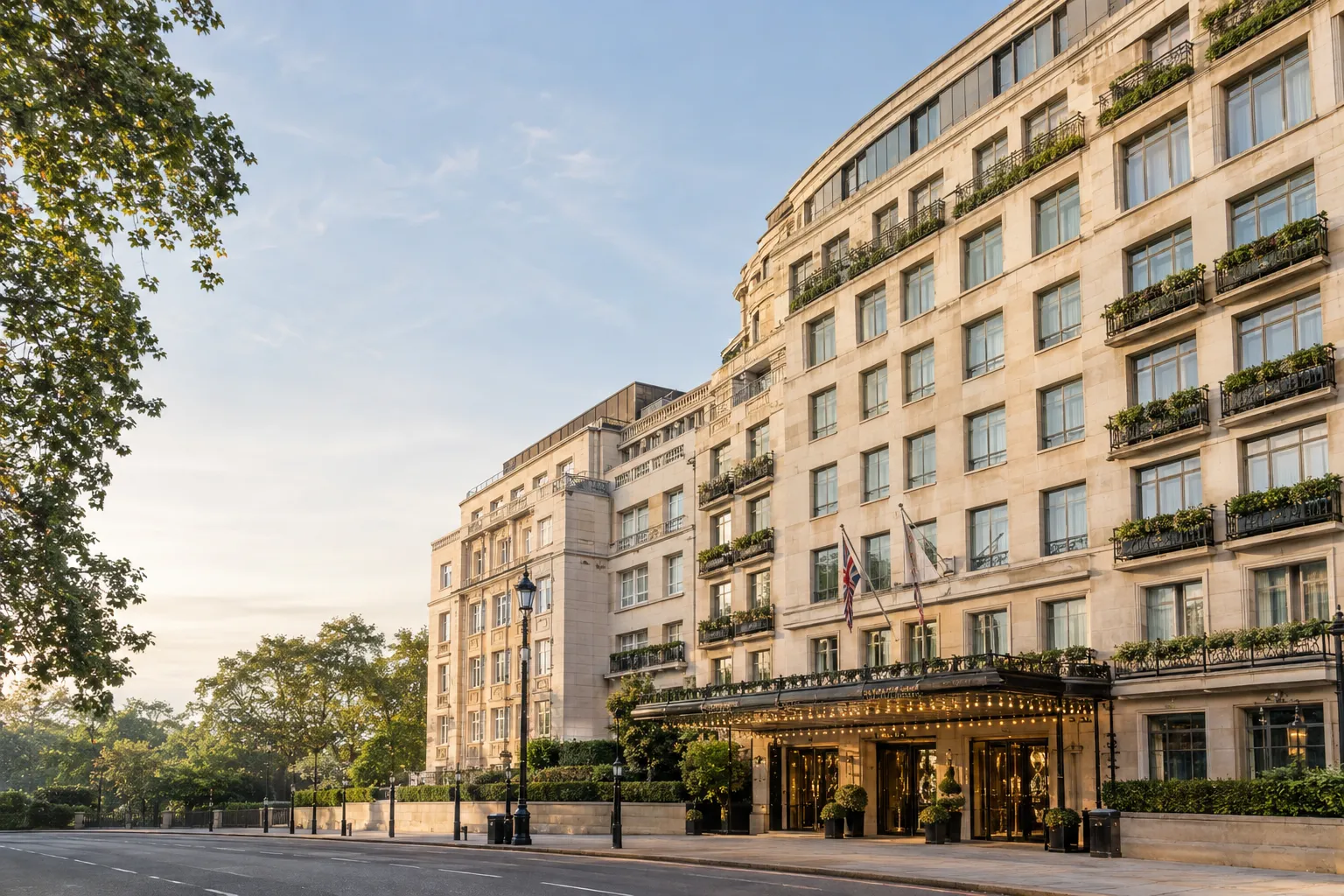
On Park Lane, beside Hyde Park and within the Mayfair setting, The Dorchester brings together a 1931 hotel, a Grade II listed building and a contemporary mix of accommodation, dining and wellness. This guide explores its history, rooms and suites, food and drink, spa facilities and the practical details worth checking before a visit.
The Dorchester is on Park Lane, beside Hyde Park and in Mayfair, London.
The hotel opened on 20 April 1931 and received Grade II listed status in 1981.
The hotel opened
20 April 1931
Listed status, awarded in 1981
Grade II
Accommodation figures listed in the hotel overview
173 rooms and 68 suites
Published general check-in and check-out times; confirm current arrangements
3 p.m. / noon
Orientation
Understanding The Dorchester Hotel Mayfair
Begin with the address and the reason for your visit. The Dorchester can be considered as a historic hotel, a place to dine or spend time, and a base from which to explore the park edge and Mayfair. Each perspective brings different practical questions.
The Dorchester Hotel Mayfair: the essentials
The Dorchester is a Park Lane hotel whose setting is part of its identity. Hyde Park lies beside it; Mayfair’s streets begin around it. The address makes the hotel a point of contact between a large central London park and a neighbourhood known for its squares, galleries, shops and dining. The building itself adds another layer: The Dorchester opened on 20 April 1931 and was designated Grade II listed in 1981. Today the hotel combines that history with accommodation, restaurants, bars and wellness facilities. This guide explains how those elements fit together and what to check when planning a stay or visit.
A place, a hotel and a neighbourhood
A useful way to understand the hotel is to consider it at three scales. First is the building and its history, which give the address a distinct identity. Second is the hotel experience itself: rooms and suites, dining, bars and spa facilities, each with its own current details. Third is the setting, where Park Lane, Hyde Park and Mayfair offer different kinds of London experience within close reach. These scales are connected, but they are not interchangeable. A room name does not guarantee a particular view, a hotel restaurant’s current arrangements may change, and a stay does not automatically include a particular park activity or neighbourhood visit. Check the specific details that matter to your plans.
History and setting
The history and setting of The Dorchester
The hotel’s past is best understood in relation to its present address. Its history, listed status and position beside the park offer context, while the surrounding district remains a living part of London.
From the 1792 site to the 1931 hotel
The site’s history reaches further back than the hotel. The Dorchester’s official account traces the property to Joseph Damer, who acquired the site in 1792. The hotel that now occupies the address opened on 20 April 1931. In 1981, the building received Grade II listed status. Taken together, these milestones place The Dorchester within a longer Mayfair history while distinguishing the hotel’s operating life from the earlier story of the site.
Listing is useful context, but it should not be mistaken for a claim that every room or interior detail is unchanged. The hotel has continued to operate and adapt. Its identity rests in part on a historic building remaining in active use, rather than on an assumption that a visitor is stepping into an untouched period interior. For a thoughtful visit, it is more accurate to hold both ideas at once: the building has recognised historic interest, and the present-day hotel is a functioning, evolving place.
Park Lane between Hyde Park and Mayfair
Park Lane gives the hotel a strong urban address, while Hyde Park supplies a contrasting landscape immediately beside it. Mayfair, in turn, is not a single attraction but a district whose character is made up of streets, squares and individual destinations. Visit London’s area guide describes Mayfair through historic streets, shopping, galleries, dining and green spaces, with places such as Bond Street, Savile Row, Shepherd Market and the Royal Academy of Arts among its points of interest.
This combination helps explain why the hotel’s location matters beyond convenience. A day can take its character from the city or from the park, and the change between those environments is part of the area’s appeal. It is still important to plan each activity independently: the hotel’s address does not establish opening times, admission arrangements or availability at nearby venues. Use current official information for any specific place you intend to visit.
The Dorchester’s official history identifies its Park Lane setting beside Hyde Park and near Mayfair.
Visit London provides neighbourhood context for Mayfair and its streets, shopping, galleries and green spaces.
Use the Royal Parks’ current visitor information to check Hyde Park access and any temporary notices.
Accommodation
Choosing a room or suite at The Dorchester
The official overview describes a substantial choice of rooms and suites. The most helpful comparison is not simply larger versus smaller; it is whether the layout, outlook and stated features fit the visit.
Start with the way you will use the room
The hotel’s official overview lists 173 rooms and 68 suites. Those figures establish the scale of its accommodation, but the useful decision for a prospective guest is more personal: which room arrangement suits the purpose of the stay? A room used mainly as a comfortable place to return to after time in London raises different priorities from a suite intended to support a longer visit or separate living and dining activities.
Compare the current room descriptions rather than relying on category names alone. Look for stated floor area, room layout, outlook and any features that are essential to you. The official accommodation pages describe individual categories and should be treated as the authority for current configurations. Photographs can help convey atmosphere, but they cannot establish that every room in a category has an identical view or arrangement. If a particular aspect matters, confirm it with the hotel before finalising plans.
Comparing room and suite descriptions
Named suites provide examples of how the choices can differ. The official room information describes the Mayfair Suite as having separate living and dining areas, with a listed area of 103 square metres. The Hyde Park Suite is listed at 106 square metres and described as having park views. These are useful reference points, not a promise that every suite has the same dimensions, outlook or configuration. The individual description and confirmed booking details matter.
If you are weighing up a suite, consider how much time you expect to spend in it, whether separate spaces would be useful and whether the outlook is a priority. For a shorter stay centred on exploring London, some features may matter less than they would during a longer visit. Make a short list of essential requirements before comparing categories, then ask the hotel to clarify anything the published description leaves uncertain. This is a more reliable approach than inferring layout from a name or image.
Compare current room descriptions for layout, stated size and outlook.
Treat a named suite as a specific category, not a guarantee that every room has identical features.
Confirm any essential room requirement directly before booking.
What to verify before selecting accommodation
The hotel’s Park Lane position makes outlook an understandable consideration, but not every room should be assumed to face Hyde Park. The official room pages identify views where they apply to a particular category. If a park view is central to your choice, check the exact room type and booking terms rather than relying on the general location of the building.
The same principle applies to other accommodation details. Current amenities, configurations and availability should be checked against the hotel’s own information. Older descriptions, third-party summaries and photographs may not reflect a room’s present specification. A careful comparison turns a broad impression of the hotel into a practical decision based on what is actually described for the room you are considering.
Food and drink
Dining and afternoon tea at The Dorchester
Dining ranges from dedicated restaurant experiences to afternoon tea and bars. Current venue information is especially important because menus, times and reservation arrangements can change.
Restaurants and bars within the hotel
The Dorchester’s official overview lists four restaurants and three bars. Its dining pages identify several distinct venues, including The Grill, Alain Ducasse, The Promenade and China Tang. This variety makes dining part of the hotel’s identity, but it also means that a visitor should choose according to the occasion rather than treating all venues as interchangeable. Cuisine, atmosphere, service format and current availability are specific to each venue and should be checked on the hotel’s current pages.
For a meal tied to a particular date, consult the relevant restaurant’s official information for menus, booking arrangements and opening details. These are changeable facts. A guide can help explain the range of settings, but it cannot guarantee that a particular menu or service is available on the day you visit.
Afternoon tea at The Promenade
Afternoon tea at The Promenade is a distinct reason to visit, including for someone who is not staying overnight. The hotel publishes the current details, menu and booking information for the experience. Treat those pages as the source for the precise format, service times, reservation requirements and any conditions that apply when you plan to go. Menu content and operational arrangements can change, so a previously saved menu should not be assumed to remain current.
A practical approach is to decide first whether afternoon tea is the main purpose of the visit or one element of a wider day. If it is the focus, allow time for the experience and confirm the relevant booking details directly. If you are combining it with a walk or another Mayfair destination, check those separate opening arrangements as well. The hotel’s location can make such a combination appealing, but it does not make the activities part of one packaged itinerary.
Check The Promenade’s current afternoon tea details before selecting a date.
Confirm menus and booking conditions with the hotel rather than relying on older material.
Check nearby attractions independently if you are combining dining with sightseeing.
Choosing a dining setting for the occasion
The presence of multiple bars creates further options within the hotel, though the right setting depends on the occasion and on what is currently offered. Consult the official dining pages for venue descriptions and practical details. If a specific bar, restaurant or seating arrangement matters, confirm it directly rather than assuming the hotel’s general overview covers every operational detail.
For visitors planning a special meal, the simplest preparation is to identify the venue, check its current menu and reservation information, and make any relevant requirements clear in advance. That keeps expectations grounded in the particular experience being considered. It also recognises that dining is one strand of the hotel’s offer, not a single uniform experience.
Wellbeing
Spa and wellness at The Dorchester
Wellness facilities contribute to the hotel’s wider offer, but individual treatments and arrangements need current confirmation. Plan around the specific service you intend to use.
Understanding the spa and fitness facilities
The hotel’s spa and wellness information describes treatment rooms, a relaxation room, a hair salon, a fitness centre and a steam room. These facilities add an indoor dimension to a stay alongside accommodation and dining. The hotel also describes personal training and gym equipment. Because the availability of individual services and appointments can vary, the current spa pages should guide any plan that depends on a particular treatment or facility.
It is useful to separate the existence of a facility from the availability of a specific service at a chosen time. A page may describe the spa overall, while treatments, appointments and other arrangements have their own details. If wellness is a central reason for visiting, check the current treatment information and ask the hotel about anything that affects your plans. If it is a secondary part of a stay, leave enough flexibility to accommodate the arrangements available during your visit.
Check the current spa information for treatments and appointments.
Confirm the availability of any facility or service that is essential to your visit.
Use the hotel’s own pages for current descriptions and arrangements.
Planning wellness time around confirmed details
The spa should be considered as one component of the hotel rather than an automatic part of every visit. Guests planning a treatment may need different information from someone simply interested in the hotel’s wellness facilities. Check whether a particular service requires advance arrangements and whether any conditions apply. Do not infer access to facilities at another address or assume that a service is included in a room booking unless the hotel explicitly confirms it for the relevant reservation.
This distinction is particularly useful when coordinating a day with dining or time outside the hotel. Establish the intended appointment or facility first, then build the rest of the schedule around confirmed details. That creates a more realistic plan than relying on a broad description of the spa alone.
Around the hotel
Exploring Hyde Park and Mayfair
The surrounding area offers two contrasting ways to spend time: Hyde Park’s open landscape and Mayfair’s urban streets. Treat nearby sightseeing as a self-guided possibility and verify the details of each destination.
Making Hyde Park part of the visit
The Dorchester sits beside Hyde Park, so a park visit can be a natural complement to time in Mayfair. The Royal Parks’ visitor information states that Hyde Park’s pedestrian and vehicle gates open at 5 a.m. and close at midnight daily, while also warning that temporary closures may be posted. Check the current park information before setting out, particularly if your plans depend on a specific entrance, route or time.
The park is large enough that a vague plan can become an unnecessarily long walk. Decide whether you want a brief change of scene or a longer visit, then consult the official map to orient yourself. The map and visitor guidance are more useful than assuming that the nearest-looking point on a map is the best entrance for your intended destination. Conditions and access notices can change; treat the Royal Parks’ current information as the authority.
Check current Hyde Park notices before visiting.
Use the official Royal Parks map to orient yourself and choose a suitable route.
Allow for the park’s scale rather than judging walking time from a broad area map alone.
A considered walk through Mayfair
Mayfair is well suited to being explored at street level, where the character of the district emerges through its individual streets and destinations. Visit London highlights its historic streets, squares, shopping, galleries, dining and green spaces. Bond Street, Savile Row, Shepherd Market and the Royal Academy of Arts offer examples of the different interests represented in and around the district. Check the relevant venue’s own information for current opening times, admission and access before building a day around it.
Rather than trying to cover every named place, choose a theme. A visitor interested in architecture and atmosphere might prioritise a relaxed neighbourhood walk; someone focused on shopping or galleries may prefer to check specific destinations and opening times in advance. The hotel’s position offers a useful starting point, but a self-guided walk is not an included hotel tour. Keep the route flexible and use current local information for the places you actually intend to enter.
Planning a flexible Mayfair and Hyde Park day
A simple day plan can combine one principal activity with time to explore, rather than trying to fit too many stops into the area. For example, a visitor might plan a confirmed dining reservation, allow time for a walk in Hyde Park, and leave the remaining hours open for a Mayfair street or gallery that interests them. This is a planning framework, not a fixed itinerary: travel time, venue access and personal pace will differ.
Check each part of the day independently. A restaurant’s reservation details do not establish park conditions, and a park map cannot confirm a gallery’s opening. If you are travelling between places, use a current journey planner for the route and conditions on the day. This guide does not promise a particular journey time or recommend an unverified transport arrangement.
Choose one main reason for the day, such as a meal, a park visit or a neighbourhood walk.
Verify every venue’s current arrangements separately.
Leave a flexible interval between activities rather than treating the area as a timed package.
Before you go
Practical planning for The Dorchester
A few simple checks help keep expectations precise. Use the hotel’s current information for hotel arrangements, and the relevant official source for nearby parks and venues.
Check-in, check-out and arrival planning
The hotel’s official overview gives general check-in from 3 p.m. and check-out by noon. These are useful reference points, not a substitute for checking the terms attached to a particular stay. Confirm current arrangements directly, especially if arrival or departure timing is important to your plans. Do not assume that early access, late departure or luggage arrangements are included unless the hotel confirms them.
For an overnight visit, work backwards from the purpose of the stay. A restaurant booking, spa appointment or planned outing may determine when you need to be ready, but each has its own arrangements. Allow time for arrival and orientation without assuming a specific journey time. Current travel conditions, route choices and access requirements should be checked separately.
Separate enduring facts from changeable details
Information about a hotel visit falls into two broad groups. Historical facts such as the opening date and listed status provide enduring context. Operational details such as restaurant menus, appointment availability, opening hours and room inventory can change. For the latter, consult the official page closest to the activity you are planning rather than relying on a general article or an old copy of a menu.
The same principle applies to the neighbourhood. Hyde Park’s current visitor notices are the relevant source for park access, while individual Mayfair venues publish their own information. If several activities are involved, create a short checklist and verify each item close to the date. This is particularly helpful when one part of the day depends on another, such as planning a walk around a reservation or an appointment.
Confirm room details and stay arrangements with the hotel.
Check the relevant restaurant or spa page for current operational information.
Review Royal Parks notices before a Hyde Park visit.
Check individual Mayfair destinations for their own hours and access details.
A practical way to plan a visit
The Dorchester is a well-defined subject for a London visit: a hotel that opened in 1931, a Grade II listed building, an address on Park Lane and a location beside Hyde Park and Mayfair. Its rooms, dining and wellness spaces offer distinct reasons to stay or visit, while the surrounding district adds options beyond the building. A more satisfying plan begins by deciding which of those elements matters most.
For accommodation, compare the current room descriptions. For a meal or afternoon tea, check the specific venue’s information. For spa time, verify the treatment and facility details. For the wider area, use the current guidance from the park authority and individual destinations. That approach respects both the history of the hotel and the practical realities of a present-day visit, without assuming that every experience is the same for every guest.
In perspective
The Dorchester Hotel Mayfair in perspective
The hotel’s character emerges from the meeting of a historic building, a central London address and a varied contemporary offer.
A hotel understood through place and purpose
The Dorchester is most clearly understood through the relationship between its history, its Park Lane address and its present-day hotel experience. The opening date and Grade II listing place it within London’s architectural story; Hyde Park and Mayfair give the address a distinctive setting; accommodation, dining and wellness provide different ways to experience the building. None of these alone tells the whole story.
For a stay, the practical details are the room category and arrangements that matter to you. For a visit centred on dining or wellness, the current venue information should guide the plan. For time outside, Hyde Park and Mayfair reward a little independent preparation. The best approach is not to assume that one broad description applies to every visit, but to identify your purpose and confirm the details that shape it. In that way, the hotel’s setting remains central while the plan stays realistic and personal.
A note on local ground travel
The publisher of this guide, London Direct Chauffeurs UK, provides chauffeur services in Mayfair, London. If your visit involves a ground journey in that area, you may consider the company for a chauffeur service; confirm service arrangements directly. This is a practical option separate from the hotel, and does not imply an affiliation between the two.
Questions answered
The Dorchester Hotel Mayfair FAQs
Where is The Dorchester in Mayfair?
The Dorchester is on Park Lane in London, beside Hyde Park and in the Mayfair area.
When did The Dorchester open?
The hotel opened on 20 April 1931.
Is The Dorchester a listed building?
Yes. The building received Grade II listed status in 1981.
How many rooms and suites does the hotel list?
The hotel’s official overview lists 173 rooms and 68 suites. Check the current room pages for descriptions and availability.
What are The Dorchester’s published check-in and check-out times?
The official overview gives check-in from 3 p.m. and check-out by noon. Confirm current arrangements with the hotel for your stay.
Can visitors have afternoon tea without staying overnight?
The Promenade publishes afternoon tea information for visitors. Check the hotel’s current details for availability, booking arrangements and the menu before planning a visit.
What should I check before visiting Hyde Park?
Consult the Royal Parks’ current Hyde Park visitor information for opening details, maps and temporary notices. The published gate hours may be affected by temporary closures.